
- You cannot add "Niue - 2021 - 1 Dollars - Faberge Egg - Twelve Monograms Egg" to the cart because the product is out of stock.
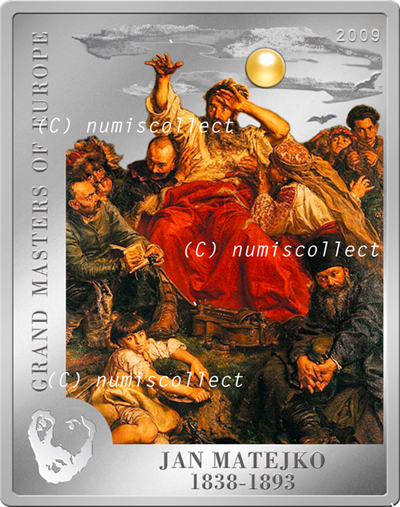
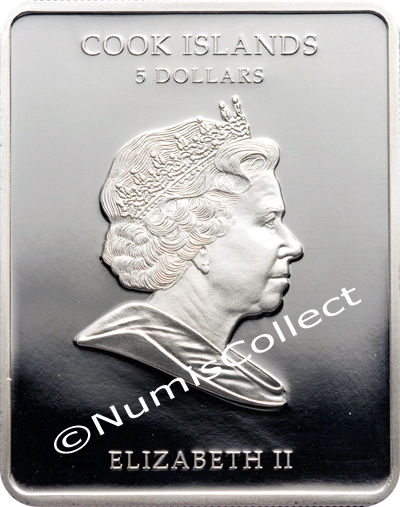
Cook Islands – 2009 – 5 Dollars – Jan Matejko Wernyhora” (serie Masters of Europe) (PROOF)”
€ 99.95
with a real pearl set in
This item is currently sold out, but we can source if for you. Click on the waitlist and be informed. This is free of charge! Contact us if you have further questions.
Description
.925 silver, 30x38mm, 25 grams, mintage 5000. color and a real pearl inserted! issue date july 2009.
Matejko was born on the 24th of June 1838 in the Free City of Kraków , part of the Polish territory annexed by Austria during the Partitions of Poland. His father, Franciszek Ksawery Matejko (Czech: Franti?ek Xaver Matějka) was a Czech from the village of Roudnice. He was a tutor and music teacher who first worked for the Wodzicki family in Kościelniki, then moved to Kraków, where he married the half-German, half-Polish Joanna Karolina Rossberg. Jan was the ninth child from eleven that his parents had. After the death of his mother in 1846, Matejko and his siblings were taken care of by his aunt, Anna Zamojska.
From his earliest days Matejko showed exceptional artistic talent that allowed him to advance from grade to grade, although he had great difficulty with other subjects. He never mastered a foreign language and did not do well even with his native Polish language. As a result, the public appearances he was obliged to make all his life must have been difficult for him.
At a young age he witnessed the Kraków revolution of 1846 and the 1848 siege of Kraków by the Austrians, the two events which ended the existence of the Free City of Kraków. His two older brothers served in them under General Józef Bem and one died.
He attended St. Ann’s High School, which he dropped out of in 1851 because of poor results. Despite that and because of his exceptional talent he studied at the School of Fine Arts in Kraków from 1852 to 1858 under Wojciech Korneli Stattler and Władysław Łuszczkiewicz.
During this time, he begun exhibiting historical paintings at the Society of Friends of the Fine Arts there (see e.g. Sigismund I Bestowing Nobility on the Professors of the University of Kraków in 1535.).
After studying under the historical painter Hermann Anschütz in Munich (1859)and then briefly and less successfully in Vienna, Matejko returned to Kraków, where he lived for the rest of his life and where, beginning in 1873, he was for many years the principal of the Academy of Fine Arts.
At that time Matejko started to gain international recognition; literally a starving artist during his younger days, in 1865, his painting Skarga’s Sermon won the gold medal at the annual Paris salon. It was subsequently purchased by Count Maurycy Potocki for 10,000 guldens.
In 1867, the painting Rejtan won the gold medal at the World Exhibition in Paris. French critics included Matejko among the most outstanding representatives of historical painting in Europe. Through his painting, he succeeded in reminding Europe that partitioned Poland still existed despite political realities.
Matejko died in Kraków and was buried in the center of the Alley of the Meritorious at Kraków’s Rakowicki Cemetery.
source: wikipedia
Related products
-

Niue – 2025 – 1 Dollars – Golden Table Clock (Timeless art of Faberge)
€ 134.95 Add to cart -

Cameroon – 2025 – 500 Francs – Simonetta Vespucci (Timeless Beauty series)
€ 79.00 Add to cart -
Palau – 2024 – 20 Dollars – Lady Godiva Eternal Sculptures II
€ 399.95 Add to cart -
Niue – 2024 – 1 Dollars – Diamond Trellis Egg
€ 74.95 Add to cart -
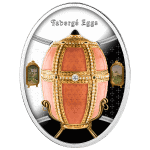
Niue – 2025 – 1 Dollars – Danish Palaces Egg (Faberge Egg series)
€ 79.95 Add to cart -
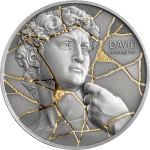
Cameroon – 2025 – 2000 Francs – David (Kintsugi Art series)
€ 365.00 Add to cart -
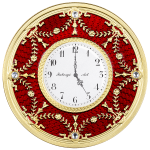
Niue – 2024 – 1 Dollars – Red Table Clock (Timeless art of Faberge)
€ 98.95 Add to cart -
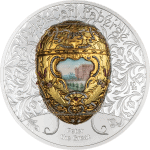
Mongolia – 2026 – 1000 Togrog – Peter the Great (Peter Carl Fabergé egg series) 2oz silver
€ 319.00 Add to cart -
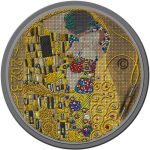
Palau – 2023 – 20 Dollars – Kiss Gustav Klimt Fine Embroidery Art
€ 449.95 Add to cart -

Niue – 2025 – 1 Dollars – Clover Leaf Egg (Faberge Egg series)
€ 79.95 Add to cart -
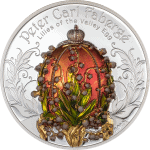
Mongolia – 2025 – 1000 Togrog – Lilies of the Valley Egg Peter Carl Fabergé 2oz silver
€ 229.95 Add to cart -
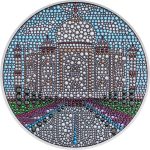
Palau – 2024 – 20 Dollars – Taj Mahal / Dot Art series
€ 399.95 Add to cart


